
Comet C/2026 A1 (MAPS) belongs to a rare group of sungrazing comets.
The sungrazing comet C/2026 A1 (MAPS) has been causing a stir in recent months as it brightened during its headlong rush towards the sun, which culminates in a high stakes close approach known to astronomers as perihelion on April 4. Here's how you can watch its final do-or-die approach for yourself through the technological eye of a sungazing spacecraft.
C/2026 A1 (MAPS) is thought to belong to the Kreutz family of comets — enigmatic solar system wanderers that are thought to have a shared progenitor and whose orbits take them perilously close to our parent star.
At perihelion, C/2026 A1 (MAPS) is expected to pass just 101,100 miles (162,700 km) from the sun's photosphere — a passage that could either spell its doom as volatiles buried beneath its surface vaporize and undermine its integrity, or may even see it shine bright enough to appear in the daytime sky.
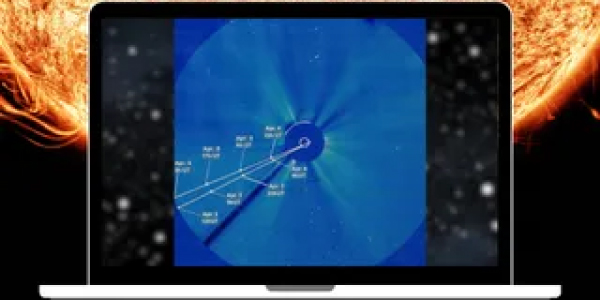
LASCO was designed to take detailed images of the sun's atmosphere by blocking out the light coming directly from its surface. Each of SOHO's "C3'" images captures a field of view 32 times the diameter of the sun, revealing how material ejected from its surface interacts with the space environment and, occasionally, detecting the presence of interlopers, such as C/2026 A1 (MAPS).
Space.com columnist Joe Rao forecast that comet C/2026 A1 (MAPS) will enter the LASCO instrument's field of view from 8:00 a.m. EDT (1200 GMT) on April 2 through to 1:00 a.m. EDT (0500 GMT) on April 6. It will briefly disappear as it passes into the blind spot created by the instrument's occulter disk for the four hours surrounding periohelion, before emerging back into LASCO's field of view, assuming it survives the close brush with our parent star.